COVID-19 Update: Additional Small Business Assistance Available from the SBA, State, and Local Sources

While much of the press – rightfully so – has been focused on the Paycheck Protection Loans created as part of the CARES Act, there are two other loans offered by the SBA that should be evaluated.

Your lender will have to give you guidance on how these three different loans work and coordinate with each other. In addition to the Paycheck Protection Loans, there are SBA Disaster Assistance Loans and Express Loans.

Disaster Assistance Loans come in the form of Economic Injury Disaster Loan (EIDL) programs or EIDL grants.

Entities eligible under EIDL loans are sole-proprietors, and other entities with under 500 employees. The loan amount is eventually determined by the SBA, but is capped at $2M. Interest rates are 3.75% for businesses and 2.75% for non-profit entities. Terms can be up to 30 years. What’s nice about these loans is that the SBA can approve them based solely on credit score and not require tax returns and other documentation. SBA also has waived the “credit elsewhere” clause and there are no personal guarantees for loans under $200,000. Applicants do need to be in business for one year.

Under this EIDL loan program, you will receive up to a $10,000 EIDL grant within 3 days of application. This is a grant and not required to be paid. If you are later approved for a loan under the Paycheck Protection Program, the grant will reduce the amount of the loan forgiveness.

You can apply online at the SBA’s website, in person, or by mail. Likewise for the SBA Express Loans. You will need some documentation however for the application process.

Philadelphia, Pennsylvania, New Jersey, Florida, New York State, New York City, Los Angeles and many states and cities have also put into place grant or loan packages.  We encourage you to visit any state and city website that you may be doing business in.

Continue to gather all your relevant financial information including your company formation documents, three years of financial statements, personal financial statements for owners over 20%, three years of tax returns – both business and personal — payroll records for 2019 and 2020, and a schedule of all debt.  You may need these documents at different times during any of the loan processes you go through.

We are here to answer your questions. Please contact us via phone at 215-723-4881, email, or our contact page.


Families First Coronavirus Response Act: Official Guidance on Emergency Paid Leave

As we have communicated, businesses with one part-time employee up to 500 employees are now required by law to officer paid sick leave (PTO) and paid family medical leave (FMLA) to their employees with the passage of the Families First Coronavirus Response Act earlier this month.  Under the act, employers with under 50 employees may file for an exemption to the new benefits.  At the passage of the Act, the Secretary of Labor was charged with providing guidance on this exemption.  On Friday, the Department of Labor posted the following in an FAQ on their website.  More details on the actual exemption application will be forthcoming.

“When does the small business exemption apply to exclude a small business from the provisions of the Emergency Paid Sick Leave Act and Emergency Family and Medical Leave Expansion Act?

An employer, including a religious or nonprofit organization, with fewer than 50 employees (small business) is exempt from providing (a) paid sick leave due to school or place of care closures or child care provider unavailability for COVID-19 related reasons and (b) expanded family and medical leave due to school or place of care closures or child care provider unavailability for COVID-19 related reasons when doing so would jeopardize the viability of the small business as a going concern. A small business may claim this exemption if an authorized officer of the business has determined that:

  • The provision of paid sick leave or expanded family and medical leave would result in the small business’s expenses and financial obligations exceeding available business revenues and cause the small business to cease operating at a minimal capacity;
  • The absence of the employee or employees requesting paid sick leave or expanded family and medical leave would entail a substantial risk to the financial health or operational capabilities of the small business because of their specialized skills, knowledge of the business, or responsibilities; or
  • There are not sufficient workers who are able, willing, and qualified, and who will be available at the time and place needed, to perform the labor or services provided by the employee or employees requesting paid sick leave or expanded family and medical leave, and these labor or services are needed for the small business to operate at a minimal capacity.

If I am a small business with fewer than 50 employees, am I exempt from the requirements to provide paid sick leave or expanded family and medical leave?

A small business is exempt from certain paid sick leave and expanded family and medical leave requirements if providing an employee such leave would jeopardize the viability of the business as a going concern. This means a small business is exempt from mandated paid sick leave or expanded family and medical leave requirements only if the:

  • employer employs fewer than 50 employees;
  • leave is requested because the child’s school or place of care is closed, or child care provider is unavailable, due to COVID-19 related reasons; and
  • an authorized officer of the business has determined that at least one of the three conditions described in Question 58 is satisfied.

The Department encourages employers and employees to collaborate to reach the best solution for maintaining the business and ensuring employee safety.

If providing childcare-related paid sick leave and expanded family and medical leave at my business with fewer than 50 employees would jeopardize the viability of my business as a going concern, how do I take advantage of the small business exemption?

To elect this small business exemption, you should document why your business with fewer than 50 employees meets the criteria set forth by the Department, which will be addressed in more detail in forthcoming regulations.”

You should not send any materials to the Department of Labor when seeking a small business exemption for paid sick leave and expanded family and medical leave.

Read the entire FAQ here.

As always, we are available to you for your questions or concerns via phone at 25-723-4881 or via email. New to Canon Capital and prefer to initiate contact online? Start here.

CARES Act Update: Additional Business Provisions

By far, the biggest business provision in the Coronavirus Aid, Relief, and Economic Security (CARES) Act was the provision of the Paycheck Protection Program loans.  However, there are many, many more powerful tax relief provisions that were included.  Here’s a summary of some of them.

Employee Retention Credit for Employers Subject to Closure Due to COVID-19

Employers can receive a refundable quarterly payroll tax credit equal to 50% of qualified wages paid to an employee.  The credit is available to employers, including non-profits, whose operations have been fully or partially suspended as a result of a government order limiting commerce, travel, or group meetings.  Eligible employers must have an average number of full-time employees in 2019 of 100 or fewer and experienced over a 50% decrease in gross receipts for the same calendar quarter in the previous year for all wages to be eligible.  Employers with over 100 average employees can only take wages paid to employees who have been furloughed or have reduced hours into account.

The eligibility of the credit must be coordinated with Small Business Interruption Loans under Sec. 1102, Paycheck Protection Program loans, Work Opportunity Credits, and required paid sick leave or required paid family leave under the Families First Coronavirus Act.

The credit applies to wages paid after March 12, 2020 and before January 1, 2021 and is capped at the first $10,000 of wages paid to each eligible employee.

Delay of Payment of Employer Payroll Taxes

Employers and self-employed taxpayers can delay payment of the employer portion of payroll taxes through the end of 2020.  Fifty percent of any payroll taxes deferred under this provision must be paid by December 31, 2021, with the remaining portion paid by December 31, 2022.

This provision does not apply to any employer who had debt forgiveness under the Paycheck Protection Program Loan.

Modification of Business Losses

Certain taxpayers with losses arising in taxable years ending after December 31, 2017 are now allowed to carryback the losses to each of the five taxable years preceding the year of the loss.  The CARES Act also removes the limitation that current year Net Operating Losses offset no more than 80% of the current year taxable income prior to such loss.  Current year losses can now offset 100% current year income.

Depreciation Correction on Qualified Improvement Property

The Tax Cuts and Jobs Act (TCJA) of 2017 defined Qualified Improvement Property (QIP) as certain improvements made to an interior portion of a non-residential building if such improvement is placed in service after the building was first placed in service.  The TCJA intended for QIPs to be depreciated over 15 years.  As a result, these improvements would have been eligible for immediate expensing under code sec 168.  However, this 15-year recovery period failed to be reflected in the statutory text of the TCJA.  As a result, QIPs have been capitalized and depreciated over a 39-year life and, in turn, not eligible for immediate expensing.

The CARES act provides the technical correction to the TCJA and specifically designates QIPs as 15-year property and eligible for immediate expensing under sec 168.

Any QIP placed in service after December 31, 2017 is eligible for this treatment.

As a result, taxpayers with QIPs placed in service in 2018, or 2019 with a return already filed, should amend their return to reflect the new treatment.

Other Odds and Ends

For large taxpayers with over $26M in average annual gross receipts, the business interest deduction cap has been increased from 30% to 50% of adjusted taxable income for 2019 and 2020.  There are special rules for partnerships and a taxpayers can elect out if they wish.  Another election to figure the deduction limit in 2020 on 2019 income is also available.

Excise taxes have either been exempted or removed for taxpayers with certain distilled spirits or aviation fuels.

If you have questions about these updates, please contact us at 215-723-4881 or via email.

Information on the Recently Passed CARES Act Paycheck Protection Program

While there is much, much more contained in the CARES Act (Coronavirus, Relief and Economic Security Act), here is a brief summary rundown of one part – the Payroll Protection Program (PPP).  The PPP is a modification of the SBA’s 7(a) program, in which the SBA partially guarantees loans made by banks to qualifying small businesses.  The 7(a) program is modified in four ways:  (1) to expand the businesses that are eligible for loans, (2) the loan terms to exclude the guarantee and collateral requirements, (3) allowing a portion of the loan to be forgiven if the borrower maintains payroll, (4) modifying the provision to incentivize banks to make the loan process more efficient and faster.

Who is Eligible?
Businesses and 501(c)(3) non-profits that:

  • Employ not more than
    • 500 employees (full time, part time, or other basis) or
    • if applicable, the SBA size standard based on NAICS code
  • Certain sole-proprietors
  • Independent Contractors
  • Other self-employed individuals
  • Financial Businesses, passive businesses, foreign businesses, gambling businesses and private clubs are NOT eligible for PPP loans

Who can make these loans?

Any lenders with delegated authority from the Small Business Administration (SBA).  The lender will evaluate the eligibility of the borrower under the PPP through:

  • Businesses were in operation as of February 15, 2020 and
  • Had employees for whom the borrower paid salaries and payroll taxes OR paid independent contractors, as reported on Form 1099-Misc

How soon will the loans be available?

Currently, SBA is re-working their website to be able to take these loan applications.  There’s obviously a lot of pressure on them to make a timely, simple, streamlined online process.  Since the government is expecting to forgive most of the loans, there is much less underwriting needed.  Thus, we believe the SBA and banks will have something in place a couple of weeks from the March 27, 2020 date when this became law.

When can I apply for the loan?

The law reads that you may apply for the loan now through June 30, 2020.  Based on the above, we recommend you gather the following documents and have them ready:

  • 2019 List of payroll paid by employee.
  • Proof that you were in business on 2/15/20.
  • There will be more but this information is not out yet.

For our payroll service clients, we have shifted two full-time staff accountants over to payroll services in order to expedite first quarter payroll tax returns.  These can serve as proof in business as of February with employees.  The other payroll calculations and information will be based on the date of the loan application.

How much can I borrow?

The maximum loan amount under the PPP is the lesser of:

  • The average total month payments by the applicant for payroll costs incurred during the 1-year period before the date on which the loan is made multiplied by 2.5*
  • PLUS, any outstanding amounts of any Emergency Injury Disaster Loan obtained on or after January 31, 2020, which is to be refinanced under this loan,
  • OR $10,000,000

Payroll costs include the sum of payments of any compensation with respect to employees that is:

  • Salaries, wages, commissions, similar compensation but limited to $100K per employee.
  • Cash tips or equivalent
  • Paid leave for vacation, parental, family, medical or sick leave
  • Allowance for dismissal or separation
  • Payments for group health benefits including insurance premiums
  • Payment of retirement benefits
  • State/local tax assessed on employee compensation
  • Some payments to independent contractors

Payroll costs DO NOT include:

  • Compensation of an individual employee’s in excess of $100,000 as prorated from February 15, 2020 to June 30, 2020
  • Taxes withheld from employees and contractors
  • Compensation of an employee who resides outside the U.S.
  • Qualified sick leave of family leave wages under the recently passed Families First Act

What can the proceeds be used for?

Between February 15, 2020 and June 30, 2020, the business can use the proceeds for the following:

  • Payroll Costs as defined
  • Continuation of group health care benefits during periods of paid sick, medical, family leave, and insurance premiums
  • Interest on a mortgage obligation
  • Rent
  • Utilities
  • Interest on debts incurred before February 15, 2020

Are there any fees, collateral, or guarantee requirements?

There are no fees, collateral, or personal guarantee requirements with PPP loans.  The loan is non-recourse.

How is the loan forgiven?

After 60 days from the date of the loan, any repayment of the loan proceeds will be forgiven for the actual costs incurred of defined expenses during the 60-day period.  As part of the forgiveness eligibility, a business cannot:

  • Reduce its employee count on a full-time equivalent basis
  • Reduce compensation to certain employees by more than 25%
  • Prepay any debt

If loan proceeds are not used for defined expenses during the period, or a business reduces its workforce, loan proceeds will be partially forgiven.  Employers are encouraged to rehire any employees who have already been laid off.  Businesses that re-hire workers previously laid off will not be penalized for having a reduced payroll at the beginning of the 60-day period and the payroll costs of such employees are eligible for forgiveness.

Documentation will have to be provided to the lender, and certifications will have to be made to establish any loan forgiveness.  If this is not done timely, none of the proceeds will be forgiven.

Any loan amounts forgiven will not be considered taxable income to the recipient.

What happens if there is only partial loan forgiveness?

The SBA is providing complete payment deferment relief for borrowers between 6 months and 1 year.  Thereafter, the balance of the loan not forgiven will be amortized over a 10-year period, with fixed interest and principal payments, with an interest rate not to exceed 4%

Please keep watch for updates as more information becomes available. Receive updates via email by signing up for our e-news. Visit CanonCapital.com and scroll to the bottom to sign up.

COVID-19 Update: Families First Coronavirus Response Act, Change to Pennsylvania Tax Filing Deadline

Here are some updates on legislation relative to the coronavirus and news about Pennsylvania’s tax filing deadline.

Families First Coronavirus Response Act Affects Businesses with Under 500 Employees

As you may be aware, the “Families First” Act (Families First Coronavirus Response Act HR 6201) was passed into law March 18, 2020.  If your company has under 500 employees, you are affected by this legislation. The Department of Labor provides a summary of the law here.

In short, this new law creates mandatory new paid time off (PTO) and new family medical leave (FMLA) mandates for employers effective April 2, 2020.  There will be an opportunity for businesses with under 50 employees to file for an exemption if the viability of the business is in question.  However, at this moment, the Secretary of Labor has not issued guidance on this new law.

Pennsylvania Tax Filing Deadline Extended to July 15, 2020

Also, as you know, the federal deadline for your tax returns and tax payments has been pushed back to July 15, 2020.  Since Pennsylvania’s law dictates that Pennsylvania’s deadline must match the federal deadline, the Pennsylvania deadline has also been moved to July 15, 2020. The Pennsylvania Institute of CPAs is currently working with localities to push their deadlines back as well.

Canon Capital is Here for You

While Canon Capital falls under Governor Wolf’s list of life-sustaining businesses, we are continuing to implement procedures to have no more than 10 individuals in our office at one time.  We continue to be available by phone or email as normal.  While Montgomery County is currently under a “stay at home” order, we will continue delivering payroll and tax returns through secure methods.

Tax Return Filing and Payment Deadlines Moved to July 15, 2020

To Our Valued Clients and Friends,

As you may have heard already, there’s a lot of breaking news today.  First and foremost, Treasury Secretary Steve Mnuchin has announced that tax returns AND payments are now both due July 15, 2020.  We believe this will extend first quarter estimates as well, but we need to wait and see.  This WILL extend the time to make IRA, SEP, and other retirement contributions that are due at the due date of the return.  We also believe that Pennsylvania will also extend their due date, but nothing has been formally announced yet for the state and local authorities.

Canon Capital has filed for a hardship exclusion for our Payroll and CPA services. While we can process taxes and payroll remotely — and we are going to be doing so — we believe we can continue to carry out our business safely, with proper staffing for density control, in our offices.

There is a lot of information out there and we believe much bigger announcements concerning taxes and relief are yet to come.   In the meantime, we encourage you to do the following:

Stay in touch with your lenders.  Much of the relief will eventually be coordinated through your lenders.  They can keep you up to date.

Stay in touch with your insurance agent.  There also have been relief proposals that may flow through business interruption insurance policies, even if viruses are an exclusion currently.

Visit the Indian Valley Chamber of Commerce website for resources.

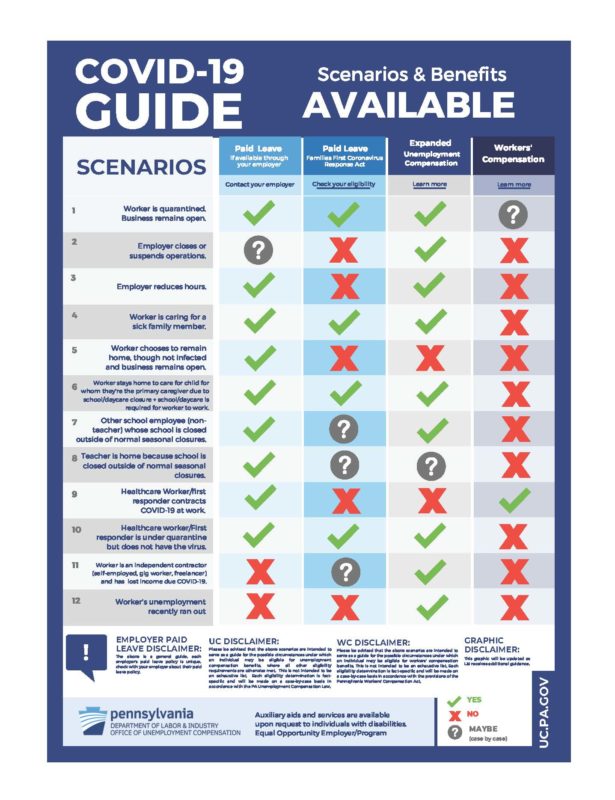
For PA Unemployment and Workers Compensation please visit their page.  A couple of notes are the waiting week for benefits is suspended, and the employer rate for unemployment tax will not be affected for COVID-19 claims.

Here is a Summary of HR 6201, Families First Coronavirus Response Act which was signed into law. This act provides or offers potential tax credits for paid sick leave.  We will put more information out on this shortly once we get settled into our remote routine.

In the meantime, please feel free to email, or call us as normal.  We continue to wish you and yours good health and safety.


Update to Our Payroll Clients – Here is the Plan

March 20, 2020

To Our Valued Payroll Service Customers and Friends:

Thank you for your patience as we prepare to serve your payroll needs remotely. We plan on doing so for the next two weeks.

Please note that ALL payroll correspondence and information must be emailed to payroll@canoncapital.com.

  • Employees with direct deposit will continue to receive direct deposit.
  • Net pay amounts for live checks will be emailed to our payroll contact in your organization. You will need to write the live check and present to your employee.

We will not have the ability to send anything via U.S. Mail or any other courier or to receive faxes while working remotely. Simply use the payroll@canoncapital.com email address.

We are available via phone as needed for questions. We will be checking our voicemail messages remotely. Dial our main number – 215-723-4881 – and select the extension for the person you wish to speak with:

Vicki Barnes, ext. 150
Linda Covel, ext. 157
Ashley Hillman, ext. 122

We are grateful for you and wish you safety and good health as we navigate these circumstances day by day.

Thank you.

COVID-19 Update: Governor Wolf’s Order Regarding Closure of Physical Business Locations Deemed Non-Life Sustaining

As you have likely heard, late yesterday (March 19, 2020) Governor Wolf issued an order closing the physical locations of all Pennsylvania businesses that are not life sustaining. Canon Capital services are deemed to fall in this category, and we will be complying with the governor’s order effective immediately.

At the same time, we intend to continue providing services to the best of our ability. Our staff will be working remotely and will be accessible via phone or email as we endeavor to be responsive and care for you as clients and friends. To call, dial our main number – 215-723-4881 – and select the appropriate extension.

You may be concerned about the individual income tax filing deadline. Here’s what we know: as we communicated earlier this week, while the deadline for the payment of any tax due has been extended to July 15, the actual filing date for the tax return itself remains April 15. Our industry has been actively lobbying federal and state representatives on this matter and a bill has been introduced in the Senate to delay the filing deadline to coincide with the July 15 payment date. We are confident that this measure will be successful, particularly given the governor’s unprecedented closure order.

As always, we will make every attempt to work with you during this very challenging time, and please don’t hesitate to contact us with your questions and any needs you may have. We will update you as we learn more. In the meantime, we wish you and yours good health and safety.

News Regarding 2020 Tax Season Deadlines

You might be seeing reports of changes to the 2020 tax season deadlines. There is a lot of misinformation being reported and the IRS has not yet issued official written guidance. Here is what we know right now. Of course, we will keep you updated as information is confirmed.

Yesterday (Tuesday, March 17, 2020) Treasury Secretary Steven Mnuchin announced that the 2020 tax payment due date has been extended by 90 days, to July 15, 2020. As far as we know, this has not yet affected the filing date, which remains at April 15, 2020.

Here is what we know about the payment deferrals:

  • Individuals may defer tax payments up to $1 million for 90 days (until July 15, 2020).
  • Corporations may defer tax payments up to $10 million for 90 days (until July 15, 2020).

In the meantime, here are some additional resources for advice to help navigate this situation:

  • Stay in touch with your lenders. Most lenders are working on some relief packages. Keeping a line of communication with them can help them to help you.
  • Contact your insurance company to see if you qualify for relief under business interruption insurance.
  • Contact your state and federal representatives and/or keep up with their newsletters/e-news. They will be a source for the relief that will soon be available.
  • The U.S. Small Business Association has guidelines on relief and small business loan resources at SBA.gov.
  • Our local Chambers of Commerce have been issuing resources and advice, regardless of membership status. Sign up for their e-newsletters.
  • For local businesses, news outlets like Patch.com, Lehigh Valley Business, Montgomery News, and The Intelligencer, are good resources to keep up with local developments.

We will continue to keep you updated. If you have any questions, please call us (215-723-4881) or contact us online.

Update Regarding Operating Practices Amid COVID-19 Concerns

To Our Valued Clients and Friends,

By now we are all aware of and concerned about the impact of the COVID-19 virus. Given Governor Wolf’s recent closing of schools and other public spaces in Montgomery County, and with the overriding motivation to do our part to protect the health of our employees, our clients, and the community at large, we are taking steps to limit exposure to the virus. These procedures will be in place for 11 days beginning Monday, March 16, 2020, and longer if necessary.

We will prioritize phone and email interaction, as well as using e-signature capabilities and video conferencing where possible, to the exclusion of face-to-face meetings in either client offices or in our office. Employee-client office visits are now limited to those that are very essential, infrequent, and brief in nature. In addition, we will not engage in client appointments in our office during this period.

Our office doors will be locked at all times. While we prefer email or fax delivery, those visitors needing to drop information off may do so at the drop box by our main entrance, where we will provide envelopes for confidentiality. Anyone needing to pick up items will be admitted to the lobby only for a brief amount of time. Where requested, we will also mail items out to clients.

Please be aware that our staff continues to operate with a high level of awareness of the client experience and want to work with you to minimize the impact of this health emergency on all of us.

Thank you for your understanding and flexibility as we all deal with these extreme circumstances, and best wishes for health to you and your families.