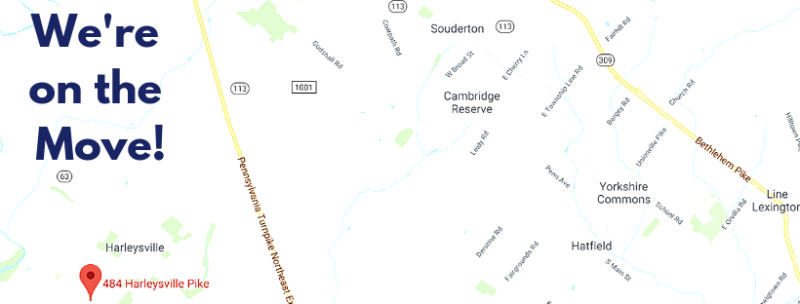

Moving Day is Here: Canon Capital is Moving to New Harleysville Location

Moving Day has arrived! Please note the following regarding our access and availability January 23-28, 2019 as we move our Hatfield and Souderton offices to our new Harleysville location:

Wealth Management
The Wealth Management office is currently in the process of moving. Staff will be accessible via phone and email.

Accounting, Payroll, & Technologies
These business units will begin moving Thursday, January 24. The Souderton office will be accessible until the end of business on Thursday, January 24. Staff will be accessible via phone and email.

There may be delays in communication during this time as we transition to the new location. We are planning that Monday, January 28, 2019 will be our first official day of business in our new location:

484 Harleysville Pike
Harleysville, PA 19438
Click for directions.

Our telephone number (215-723-4881) remains the same.

Thank you.


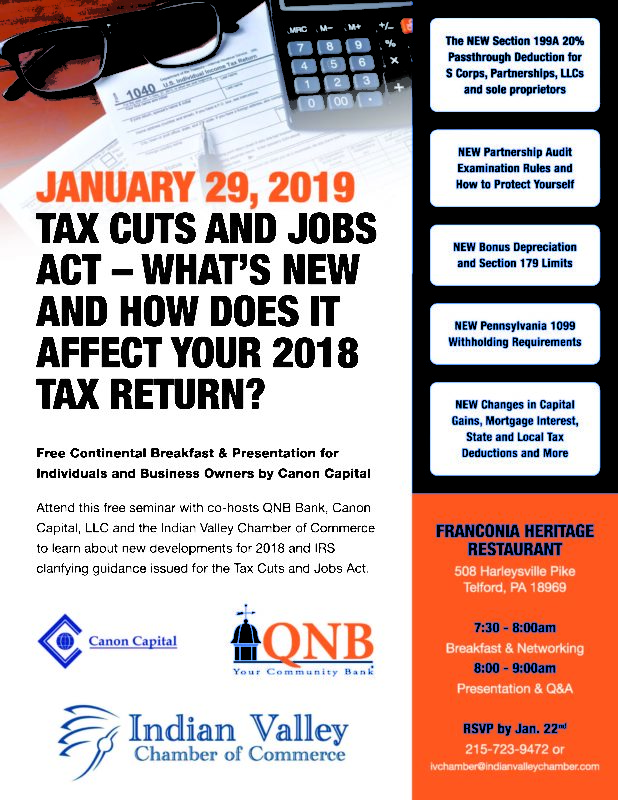
Join us January 29 for a Free Seminar – The Tax Cuts and Jobs Act: What’s New?

Are you a business owner curious about what the new developments will mean for your 2018 return? Then join us Tuesday, January 29 as we, along with QNB Bank and the Indian Valley Chamber of Commerce, share the latest updates, including:

  • NEW Section 199A 20% Passthrough Deduction for S Corps, Partnerships, LLC’s and sole proprietors
  • NEW Partnerships Audit Examination Rules and How to Protect Yourself
  • NEW Bonus Depreciation and Section 179 Limits
  • NEW Pennsylvania 1099 Withholding Requirements
  • NEW Changes in Capital Gains, Mortgage Interest, State and Local Tax Deductions and More

Register with the Indian Valley Chamber of Commerce online or via phone at 215-723-9472 by January 22, 2019.

(Download the event flyer.)

Be Prepared with Our 2018-19 Tax Planning Guide

The full impact of the Tax Cuts and Jobs Act of 2017 will be realized with the filing of 2018 returns. Be prepared by consulting our 2018-19 Tax Planning Guide. Stay up to date with the most recent tax news and the latest facts, with relevant information for individuals, investors, and business owners.

This resource is available to you right now. It is the first item listed on the Useful CPA Links and Resources page of our website.

If you have any questions about this or any other element of your tax planning, we are glad to be of service. Call 215-723-4881 or contact us online.

Canon Capital’s Special Guests Greet Reindeer Runners

On Saturday, December 1, 2018, we continued our annual tradition of providing a water station as participants in the Generations of Indian Valley Annual Reindeer Run complete the unforgiving hill of Main Street Souderton. Our own Sarah Hughes (who finished in first place in her category) and Brian Erkes participated alongside the rest of the reindeer antlered, ugly sweater-wearing runners and walkers. We even spotted Batman! However, they couldn’t top our water station volunteers; Canon Capital’s Mike Witter was joined by The Grinch and the big man himself, Santa Claus. The Reindeer Run benefits the programs of Generations of Indian Valley, including their Meals on Wheels service.

View the complete photo gallery on our Canon Capital Facebook page and the Generations of Indian Valley Facebook page.

UPDATE to Can I Deduct That? News on Changes to Meals and Entertainment Expenses

We recently shared the changes brought to Meals and Entertainment expense deductions as a result of the Tax Cuts and Jobs Act. Since first sharing that information, the IRS has issued additional guidance on these deductions.

Under this interim guidance, issued October 3, 2018, meals for entertaining clients, prospects, and the like remain 50% deductible, meaning taxpayers may deduct 50% of an otherwise allowable business meal expense if:

  • The expense is ordinary and necessary.
  • The expense is not lavish or extravagant.
  • The taxpayer or taxpayer’s employee(s) is/are present at the meal.
  • Food and beverage are purchased separately from any entertainment, or the food and beverage cost is separately stated on the invoice.

Taxpayers may rely on this guidance pending the issuance of proposed regulations by the IRS.

To see a side-by-side comparison of all that has changed, download our FREE Guide to Deductible Meals and Entertainment Expenses.


By submitting this form, you are consenting to receive marketing emails from: Canon Capital Management Group, LLC, 484 Harleysville Pike, Harleysville, PA, 19438, https://www.canoncapital.com. You can revoke your consent to receive emails at any time by using the SafeUnsubscribe® link, found at the bottom of every email. Emails are serviced by Constant Contact


If you have questions or would like to set up a tax planning session, contact us online or call 215-723-4881.

Should You Choose a Different Business Structure After the Tax Cuts and Jobs Act?

The Tax Cuts and Jobs Act was passed by Congress in November of 2017 but did not take effect until the beginning of this tax year (2018). It brings enough significant change to the tax code to prompt the question, “Should I choose a different structure for my business to take full advantage of this new law?” Our answer: “Yes, No, Maybe.”

Fortunately, those are the only three choices. Unfortunately, these otherwise simple choices become more complicated when associated with the tax code. As you can probably imagine, one size does not fit all when it comes to tax planning.  It never did.  And, with the Tax Cuts and Jobs Act, one size doesn’t even fit one size anymore.

For instance, if you’re a business owner whose company is structured in any way other than a C-corporation, you might be aware of the new “Qualified Business Income Deduction.” With the Qualified Business Income Deduction, you get to deduct 20% of your flow-through business income on your personal tax return and pay tax on 80% of the business income. Sounds simple, right? This section of tax law has more restrictions and limitations – we’ll call them “weeds” – than Round-Up could ever hope to control, but we’ll keep the explanation that simple to gain a general understanding.

If your business is a Sole Proprietorship with no payroll and no assets that nets $200,000 – absent of any “weeds” – you get a whopping $40,000 deduction and pay tax on only $160,000 of your net income.  Since a sole proprietorship does not differentiate between the business and the owner, the owner is entitled to take the full $200,000 “out of the business” without any tax consequences.

Ah, but now here comes a “weed.”  Corporations are required to pay salaries to the owner for the money they take out of the business. Partnerships must classify the money the owner takes out for services as “guaranteed payments.” Both salaries and guaranteed payments do not qualify for the 20% deduction mentioned above.

Therefore, if the Corporation or Partnership has the same $200,000 net annual income, and they pay a salary (Corporation) or guaranteed payment (Partnership) of $80,000, then what remains eligible for the 20% deduction is the $120,000 bottom line business income. So, a business organized as a Corporation or Partnership, doing the same exchange for services as a Sole Proprietorship, netting the same annual income, will only qualify for a $24,000 deduction. The only difference between the three? Their business entity structure.  And so, one size – each one is a business — isn’t truly one size under the Tax Cuts and Jobs Act.

By now you’re probably thinking, the best recommendation would be to structure your business as a Sole Proprietor if your business type allows for that to make sense. Yes, but, what happens when the business is even more profitable than $200,000 per year? Let’s say that in 2019, you net $500,000 (before salaries or guaranteed payments). That’s when the “weeds” really take over, and their explanation would require a dissertation, not a blog post. Take our word for it. With such an increase in income, under the Tax Cuts and Jobs Act, the Sole Proprietor, and Partnership businesses would not qualify for any deduction. And yet, an S-Corporation that is the same business, providing the same services, netting the same income, would qualify for a $62,500 deduction.

So, not only is “one size fits all” a thing of the past. “One size” isn’t even “one size” from year to year. What happens when your Sole Proprietorship profit is low one year and high the next? You can’t switch business entities each year based on projected income. So, based on the current realities of the tax code, what is the wisest move for a business owner? Absent any other information, the recommendation would be to do business as an S-Corp.

This new tax code will affect every business in the United States, regardless of size or entity structure, which is how we arrived at our initial answer to the question, “Should I change my business structure under the Tax Cuts and Jobs Act?” is “Yes. No. Maybe.”

Let’s find out what entity will be right for you. Contact us online or call 215-723-4881 to schedule a consultation.

How to Complete a Form W-4: Updated for 2021

It’s always a good idea to do a “Paycheck Check-up” at the start of the new tax year or when you experience any change in your income, to make any necessary adjustments to your Form W-4 (Employee’s Withholding Allowance Certificate). Doing so helps to avoid withholding too little Federal tax from each paycheck, which could lead to an unwelcome tax bill or penalties. All that requires is updating the Form W-4 on file with your employer.

The IRS provides an online Withholding Calculator to help you determine the right type of withholding for your situation. But even with this calculator, completing a Form W-4 can be confusing. Let’s break it down:

Sections 1 and 5
These are straightforward, requesting your name, Social Security number, address, marital/filing status, whether or not your name matches your Social Security Card, and your signature.

Sections 2-4
These sections are to be completed only if they apply to your situation, whether you are married, filing jointly, and if your spouse and/or if you hold more than one job at a time. Complete the Two Earners/Multiple Jobs Worksheet on your W-4 to determine these entries.

You may adjust your withholding amounts via an updated Form W-4 as often as necessary for your situation. Outside of changes in your income or tax law, you will also need to complete an updated Form W-4 with these life events:

  • Change of address (especially if you move to a new town/township/city/state)
  • Change in marital status/marital filing status
  • Name change

If you have any questions, we’re here to help. Contact us online or call 215-723-4881.

Download our FREE Sample Form W-4, where we take you through each question using a sample scenario.


By submitting this form, you are consenting to receive marketing emails from: Canon Capital Management Group, LLC, 484 Harleysville Pike, Harleysville, PA, 19438, https://www.canoncapital.com. You can revoke your consent to receive emails at any time by using the SafeUnsubscribe® link, found at the bottom of every email. Emails are serviced by Constant Contact

Philadelphia Wage Tax Changes July 1, 2018

July 1, 2018 marks the beginning of the new fiscal year for the City of Philadelphia and with it a reduction in the Wage Tax.

The Wage Tax affects all businesses that operate within the city as well as businesses outside of the city who hire Philadelphia residents.

Any paycheck issued with a pay date after June 30, 2018 must withhold the Philadelphia City Wage Tax at these new rates:

  • 3.8809% (.038809) for Philadelphia residents
  • 3.4567% (.034567) for non-residents

If you are a Philadelphia-based business who does not collect the Wage Tax on behalf of your employees, or if you work for a business in Philadelphia and do not have the Wage Tax collected on your behalf, you – the employee – are responsible to pay an Earnings Tax directly to the City of Philadelphia. These rates will also be lower as of July 1, 2018:

  • 3.8809% (.038809) for Philadelphia residents
  • 3.4567% (.034567) for non-residents

We are happy to answer any questions you might have regarding this or any issue related to your payroll. Call 215-723-4881 or contact us online.

Team Canon Capital Participates in the Indian Creek Foundation 2018 Roll, Stroll & Run

On Saturday, June 16, 2018, Team Canon Capital joined the many participants in Indian Creek Foundation’s annual Roll, Stroll & Run, an event including opportunities to raise funds by running, walking, or cycling.

Canon Capital Payroll processer/tax preparer Linda Covel brought some family members along for the 5K walk while Canon Capital Wealth Management project coordinator, Brian Erkes, his wife, Janice, and son, Frank, ran in the timed 5K portion of the event, where they placed within the top 15 participants.

In addition to sending a team, we served as the event’s Volunteer Shirt Sponsor.

We are proud to support the efforts of Indian Creek Foundation, whose mission is “to provide opportunities for people with intellectual and developmental disabilities to live in and enrich the community throughout their lives.”